IEI is one of the 16 Socionics types, known as The Romantic or INFp in MBTI cousin notation. IEI belongs to the Beta quadra and is characterised by leading Introverted Intuition (Ni) and creative Extraverted Ethics (Fe). The Dual of IEI is SLE (The Marshal).
Function positions
The eight positions of Model A for IEI. Classical names are shown with SLIDE System™ equivalents; position 4 is also commonly called the PoLR (Point of Least Resistance).
| # | Position | Function | Strength |
|---|---|---|---|
| 1 | Leading (Enthusiastic Driver) | Introverted Intuition (Ni) | Strong |
| 2 | Creative (Adventurous Discoverer) | Extraverted Ethics (Fe) | Strong |
| 3 | Role (Underlying Referee) | Introverted Sensing (Si) | Weak |
| 4 | Vulnerable (Rising Guru) | Extraverted Logic (Te) | Weak |
| 5 | Suggestive (Subdued Dreamer) | Extraverted Sensing (Se) | Weak |
| 6 | Mobilising (Hidden Motivator) | Introverted Logic (Ti) | Weak |
| 7 | Ignoring (Data Recorder) | Extraverted Intuition (Ne) | Strong |
| 8 | Demonstrative (Natural Artisan) | Introverted Ethics (Fi) | Strong |
General Mood
Wacky, goofy, dreamy. The natural clown. Deeply interested in people's inner lives and where they are headed emotionally.
The SLIDE System™ View — IEI
Cognitive signature. IEI leads with Reality Distillation (Ni) as its Enthusiastic Driver and Social Interest (Fe) as its Adventurous Discoverer. This is a mind that lives partly in time. The leading attitude tracks where things are heading — the undertow beneath events, the shape of what is coming, the meaning folded into small signs — and the creative attitude gives that vision an emotional voice, often lyrical or evocative. IEIs are receptive rather than driving: they wait, sense, and let impressions gather, then express what they have caught in a way that moves others. Their thinking is symbolic and associative, drawn to atmosphere and resonance more than to fact or force. The recognisable texture is a soft, dreamy presence with an unexpectedly accurate feel for how a situation will unfold. An IEI may seem slow or unworldly, then name exactly where a relationship or a plan is quietly going — a perceptiveness others miss because it arrives as mood rather than argument.
Strengths. The strong end of the IEI stack is built for insight and resonance. Leading Reality Distillation (Ni) supplies a genuine sense of trajectory — reading momentum, timing, and consequence before they are obvious — while second-position Social Interest (Fe) turns that into emotional communication that can shift how others feel. Beneath the surface, the Data Recorder position (Ne, seventh) quietly registers alternative possibilities and hidden potential, and the Natural Artisan position (Fi, eighth) lends a deep, private attunement to individual bonds. The combined effect is a type gifted at meaning: sensing the right moment, articulating what others feel but cannot say, and offering a kind of imaginative and emotional companionship that reframes experience. IEIs are at their best where perception and expression matter more than action — in art, insight, and the quiet reading of people and moments.
Blind spots. The cost is carried by Practical Results (Te) in the Rising Guru position — the IEI's Point of Least Resistance. The impersonal machinery of getting things done — logistics, efficiency, sustained productive output, the cold audit of whether effort is paying off — is genuinely draining for them. IEIs can drift, defer, and let practical matters accumulate while attention stays on the inner and the symbolic. The weak Underlying Referee (Si, third position) compounds this: steady physical self-maintenance and comfort management are easily neglected, so energy and routine can slide. None of this is idleness by temperament — it is a real mismatch between where the type's attention naturally goes and what daily practicality demands. Treated with patience, the IEI thrives when someone supplies the executive push and lets them supply the vision, rather than being shamed for a weakness that is structural.
Under stress. The IEI's classified stress disposition is Hyperesthetic — finely attuned to atmosphere and relational nuance, thin-skinned in a way that is both the source of their perceptiveness and their exposure. The need is to feel elevated and spiritually significant, valued for their sensitivity and vision. When that recognition is missing and the environment feels coarse or dismissive, the antennae that give them insight turn against them as a wash of inadequacy and futility. Under sustained load, or when the Te vulnerability is repeatedly triggered by practical demands they cannot meet, the IEI can sink into passivity, melancholy, or vivid pessimism about the future they sense so acutely. Their profile points to the adjustment: detach a little, invest less in every signal. A stressed IEI recovers when their inner world is met with gentleness and they are relieved of the practical pressure they cannot carry alone.
In relationships. The IEI's natural counterpart is the SLE (The Marshal), and the pairing shows what the type needs. IEIs offer emotional depth, imaginative companionship, and an unusual gift for understanding a partner's inner life and timing. What they need in return is grounding and force — someone decisive and physically present to provide, to clear obstacles, and to give their drifting perceptiveness a stable centre and a reason to engage the real world. Without that anchor, IEIs can retreat so far into the inner life that little gets lived. In love and friendship they are devoted, perceptive, and emotionally generous, and they flourish opposite a partner whose strength and decisiveness make it safe for them to dream, and who values the vision they bring to a life that would otherwise be all action.
A Classical Perspective
For readers interested in how IEI has traditionally been described in the Socionics literature, the following is a classical account:
A somewhat idealistic romanticist. The IEI is prone more to reflection than to action. An individualist, they are little concerned with the present — they are more excited by brilliant perspectives of bright cities that may one day be built.
Their emotionality is high; they understand the feelings of others very well and do not hide their own. But their emotionality is always somewhat restrained in order to observe the effect it produces. They express emotions not when another's patience would be exhausted, but when they themselves consider it necessary. Their way of handling emotions is highly creative — they may consider rage to be ethical and restraint non-ethical.
Easily infatuated. What makes another person stand out for the IEI is forcefulness, drive, and insightfulness — naturally, if that force lends itself to the influence of their emotions. They are very tolerant, understand people, and try to forgive their weaknesses.
Tutankhamon's smile. In extreme conditions their line of defence is to demonstrate their attitude toward the situation and reveal its comical aspects. They have a fine sense of humour and a very characteristic transparent smile that appears at critical moments — warm, warming, and exciting. Yet in most cases that smile is caused by inner anxiety; its natural purpose is to raise the partner's fighting spirit and stir them up.
Elegant. The IEI comes across as steady and upright. They practically never squint, and rarely lower their arched eyebrows. Elegance is an everyday thing with them, not reserved for special occasions. One seldom sees them in a non-aesthetic pose; their voice intonations are refined and their movements plastic, even rhythmic.
Two things are therefore surprising: they do not care much for the elegance of others (their dual, the SLE, is emphatically non-demonstrative), and chaos reigns in their living quarters. Both things and people that enter their home should find their places by themselves, or with someone else's help.
A fighter for emotional naturalness. The IEI feels responsibility for the mood of friends and relatives, for their vital tonus. They use their sense of humour to make others laugh and shake them up. In company they scan the room not to see what people are wearing but to notice how each person is feeling — that is precisely what they need in order to relate.
They dream of bringing harmony into society. History, to them, is the history of the arts. They strive for beauty — whether poetry, painting, or even attractive trinkets — and aspire to be refined themselves. They adore communication with artists, poets, bohemians, and exotic people generally.
→ See notable IEI personalities for real-world examples of this type in action.
Small Groups
| Group | Membership |
|---|---|
| Quadra | Beta |
| Club | Humanitarian |
| Temperament | Irrational-Introvert |
| Stimulus | Confident |
| Argumentation | Diplomat |
| Romance Style | Victim (Gulenko) |
| Communication Style | Sincere (Gulenko) |
| Pedagogic Need | Utopianist (Stern) |
| Stress Behaviour | Hyperesthetic (Kretschmer) |
Intertype Relations
| Relation | Type |
|---|---|
| Identity | IEI (INFp) |
| Dual | SLE (ESTp) |
| Activator | LSI (ISTj) |
| Mirror | EIE (ENFj) |
| Kindred | ILI (INTp) |
| Semi-dual | SEE (ESFp) |
| Business | SEI (ISFp) |
| Quasi-identity | EII (INFj) |
| Beneficiary | LII (INTj) |
| Benefactor | ESI (ISFj) |
| Supervisor | LIE (ENTj) |
| Supervises | ESE (ESFj) |
| Super-ego | SLI (ISTp) |
| Extinguishment | IEE (ENFp) |
| Mirage | ILE (ENTp) |
| Conflict | LSE (ESTj) |
Reinin Attributes
| Dichotomy | IEI |
|---|---|
| Judicious/Decisive | Decisive |
| Subjectivist/Objectivist | Subjectivist |
| Democratic/Aristocratic | Aristocratic |
| Process/Result | Result |
| Carefree/Farsighted | Farsighted |
| Yielding/Obstinate | Yielding |
| Static/Dynamic | Dynamic |
| Tactical/Strategic | Tactical |
| Constructivist/Emotivist | Emotivist |
| Positivist/Negativist | Positivist |
| Asking/Declaring | Asking |
See the Reinin dichotomies article for descriptions of each trait.
Type Comparisons
Detailed side-by-side comparisons of IEI with every other type — covering function stack differences, the intertype relation, and how each pairing tends to play out.
From MBTI
If you arrived at Socionics through MBTI, these pages explain how the closest MBTI types map to IEI:
Notable IEIs
Dana Scully is a useful fictional counterweight to the softer IEI stereotype: the same leading Ni, deployed as sustained professional scepticism.
Read the Book
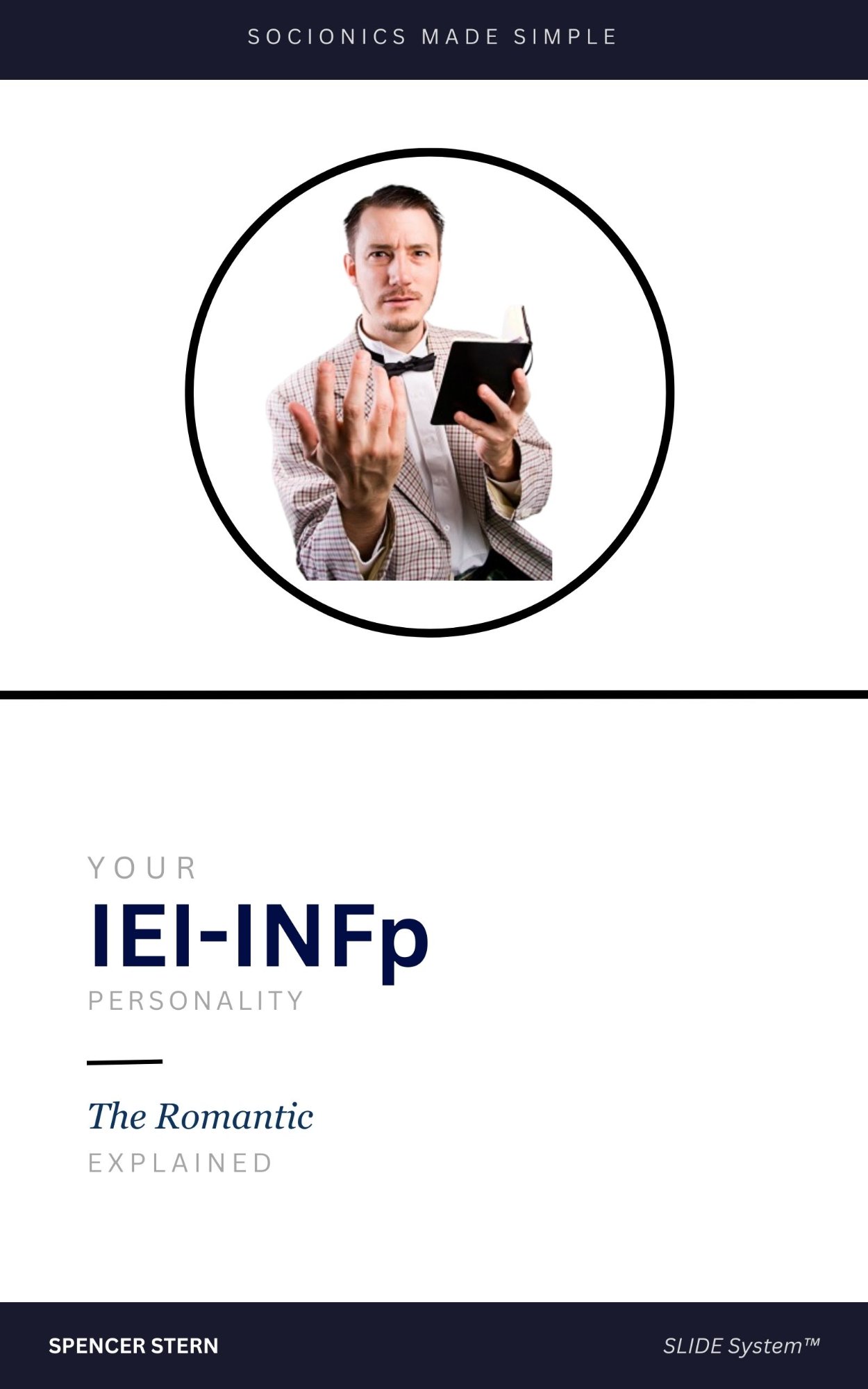
Go deeper with the IEI: The Romantic volume from the Socionics Made Simple series — a focused guide to this type's cognitive functions, strengths, blind spots and relationship patterns.
Read the IEI volume on Amazon →