IEE is one of the 16 Socionics types, known as The Psychologist or ENFp in MBTI cousin notation. IEE belongs to the Delta quadra and is characterised by leading Extraverted Intuition (Ne) and creative Introverted Ethics (Fi). The Dual of IEE is SLI (The Craftsman).
Function positions
The eight positions of Model A for IEE. Classical names are shown with SLIDE System™ equivalents; position 4 is also commonly called the PoLR (Point of Least Resistance).
| # | Position | Function | Strength |
|---|---|---|---|
| 1 | Leading (Enthusiastic Driver) | Extraverted Intuition (Ne) | Strong |
| 2 | Creative (Adventurous Discoverer) | Introverted Ethics (Fi) | Strong |
| 3 | Role (Underlying Referee) | Extraverted Sensing (Se) | Weak |
| 4 | Vulnerable (Rising Guru) | Introverted Logic (Ti) | Weak |
| 5 | Suggestive (Subdued Dreamer) | Introverted Sensing (Si) | Weak |
| 6 | Mobilising (Hidden Motivator) | Extraverted Logic (Te) | Weak |
| 7 | Ignoring (Data Recorder) | Introverted Intuition (Ni) | Strong |
| 8 | Demonstrative (Natural Artisan) | Extraverted Ethics (Fe) | Strong |
General Mood
Playful, with a tinge of irony. Warm and accepting. A frivolous surface over genuine curiosity about people and relationships.
The SLIDE System™ View — IEE
Cognitive signature. IEE leads with Creative Thinking (Ne) as its Enthusiastic Driver and Ethical Harmony (Fi) as its Adventurous Discoverer. This is curiosity about people run through a private moral filter. The leading attitude scans for potential — in ideas, in situations, and above all in individuals, noticing the talent or possibility others overlook — and the creative attitude weighs what it finds against a personal read of character and worth. IEEs are drawn to help people become what they could be, and they experience that as recognition rather than persuasion. Their thinking is exploratory and person-centred; they follow interest and intuition, alighting on possibilities and moving on when the spark fades. The recognisable texture is warm, mobile enthusiasm. An IEE lights up around new people and unrealised potential, reads individual character quickly and often accurately, and brings an infectious sense that more is possible — for a project, a plan, or a person who had stopped believing it of themselves.
Strengths. The strong end of the IEE stack is built for seeing and drawing out potential. Leading Creative Thinking (Ne) supplies a gift for possibility — spotting talent, opportunity, and the unexpected angle — while second-position Ethical Harmony (Fi) grounds it in genuine care for the particular person, so the encouragement lands as understanding rather than flattery. Beneath the surface, the Data Recorder position (Ni, seventh) quietly tracks how things may develop over time, and the Natural Artisan position (Fe, eighth) lets IEEs energise and connect a group when they choose to. The combined effect is a type gifted at development and connection: mentoring, matchmaking in the broad sense, opening doors, and helping people and ideas find the form they were reaching for. IEEs are at their best where human potential needs a catalyst and someone has to believe in it first.
Blind spots. The cost is carried by Academic Knowledge (Ti) in the Rising Guru position — the IEE's Point of Least Resistance. Rigorous internal structure — sustained logical consistency, formal systems, the patient grind of getting a framework exactly right — is genuinely tiring and elusive for them. IEEs can leave ideas half-built, resist the discipline of finishing, and grow restless when a task demands methodical rigour over open exploration. The weak Underlying Referee (Se, third position) compounds this: direct force and territorial pressure are not their register, so they can avoid necessary confrontation and scatter their considerable energy across too many possibilities at once. None of this is flightiness by character — it is a real mismatch between the type's expansive attention and the demands of structure and follow-through. Treated with patience, the IEE thrives when someone supplies the grounding and completion their exploration outruns.
Under stress. The IEE's classified stress disposition is Hyperesthetic — finely tuned to people and atmosphere, thin-skinned in a way that feeds both their insight and their exposure. The need is to feel elevated and valued — recognised for their perceptiveness and their care for others' growth. When that recognition is missing and the environment feels cold or dismissive, the sensitivity that lets them read people turns against them as self-doubt and a sense of not being enough. Under sustained load, or when the Ti vulnerability is repeatedly triggered by demands for rigour and closure they cannot easily meet, the IEE can scatter further, chasing new possibilities to escape the pressure of the unfinished, or sink into uncharacteristic gloom. Their profile points to the adjustment: detach a little, invest less in every reaction. A stressed IEE recovers when their gifts are genuinely appreciated and they are freed to move without the weight of unfinished structure.
In relationships. The IEE's natural counterpart is the SLI (The Craftsman), and the pairing reveals what the type needs. IEEs offer encouragement, insight into a partner's potential, and a warmth that makes people feel seen and believed in. What they need in return is grounding and steady practicality — someone calm and capable to supply the sensory comfort and reliable follow-through their mobile attention does not generate, and to be a still point their enthusiasm can return to. Without that anchor, IEEs can spread themselves across too many people and projects and leave themselves depleted. In love and friendship they are affectionate, perceptive, and generous with belief in others, and they flourish opposite a partner whose quiet competence and constancy give their restless curiosity a home to explore from rather than a void to fill.
A Classical Perspective
For readers interested in how IEE has traditionally been described in the Socionics literature, the following is a classical account:
An ardent enthusiast. The IEE is a highly spiritual, artistic individual. They resolve personal problems quickly, always relying on their talent for immediate improvisation rather than advance preparation. They love situations where new and exciting undertakings arise, where it is possible to demonstrate their own and others' talents, and where the most unusual development of events is still possible.
A Don Juan. They measure the virtues and talents in the people they meet and cannot hold back from reporting their observations with great enthusiasm. Others frequently mistake this dramatic display of emotion for genuine romantic interest, earning them a reputation as a Don Juan. In fact, the IEE is quite conservative in their feelings — deeply attached to a close circle of friends whose opinions carry great weight and entirely shape their mood, behaviour, and outlook. If they really are a playboy, they do not hide it.
Sensitive. Their speech is often romantic, their smiles enticing — but very often that is as far as it goes. Their motto might be: emotional power over all and sexual freedom from all.
"Modest." As a rule, the IEE is not ambitious — they can find contentment in their circle of friends and the anticipation of something interesting. Unlike types who prefer to be obvious rulers of a situation, they prefer to be its covert ruler. Their influence is directed primarily toward making other people reveal their own skills and talents.
A scientist. The IEE is sensitive about how others evaluate their intellectual abilities. They often strive for academic credentials and recognition — not for prestige, but because it allows them to work with a clear conscience. They are touchy when others criticise ideas they hold dear or deny the talents of themselves or their friends, which is why they prefer the company of those who share their beliefs.
A person of mood. Their mood determines everything: plans for the future, self-estimation, ideas about the world. Ambitious plans can shift to disappointment and sadness; but interesting news, praise, or an unexpected opportunity immediately lifts their spirits. Boredom can even make them unwell.
Altruistic. The IEE is ready to help others with personal problems and takes genuine pleasure in finding a way out of situations others consider hopeless. They are capable of showing warmth and goodwill to everyone, but reserve their real efforts for those they are serious about — and in those cases they do far more than anyone expects, and more than they themselves ever promised.
→ See notable IEE personalities for real-world examples of this type in action.
Small Groups
| Group | Membership |
|---|---|
| Quadra | Delta |
| Club | Humanitarian |
| Temperament | Irrational-Extrovert |
| Stimulus | Distinguished |
| Argumentation | Diplomat |
| Romance Style | Infantile (Gulenko) |
| Communication Style | Passionate (Gulenko) |
| Pedagogic Need | Utopianist (Stern) |
| Stress Behaviour | Hyperesthetic (Kretschmer) |
Intertype Relations
| Relation | Type |
|---|---|
| Identity | IEE (ENFp) |
| Dual | SLI (ISTp) |
| Activator | LSE (ESTj) |
| Mirror | EII (INFj) |
| Kindred | ILE (ENTp) |
| Semi-dual | SEI (ISFp) |
| Business | SEE (ESFp) |
| Quasi-identity | EIE (ENFj) |
| Benefactor | ESE (ESFj) |
| Beneficiary | LIE (ENTj) |
| Supervisor | LII (INTj) |
| Supervises | ESI (ISFj) |
| Super-ego | SLE (ESTp) |
| Extinguishment | IEI (INFp) |
| Mirage | ILI (INTp) |
| Conflict | LSI (ISTj) |
Reinin Attributes
| Dichotomy | IEE |
|---|---|
| Judicious/Decisive | Judicious |
| Subjectivist/Objectivist | Objectivist |
| Democratic/Aristocratic | Aristocratic |
| Process/Result | Result |
| Carefree/Farsighted | Carefree |
| Yielding/Obstinate | Obstinate |
| Static/Dynamic | Static |
| Tactical/Strategic | Tactical |
| Constructivist/Emotivist | Emotivist |
| Positivist/Negativist | Negativist |
| Asking/Declaring | Declaring |
See the Reinin dichotomies article for descriptions of each trait.
Type Comparisons
Detailed side-by-side comparisons of IEE with every other type — covering function stack differences, the intertype relation, and how each pairing tends to play out.
From MBTI
If you arrived at Socionics through MBTI, these pages explain how the closest MBTI types map to IEE:
Notable IEEs
For a fictional example a long way from the type's usual warm framing, Chev Chelios in Crank is a genuinely visceral IEE.
Read the Book
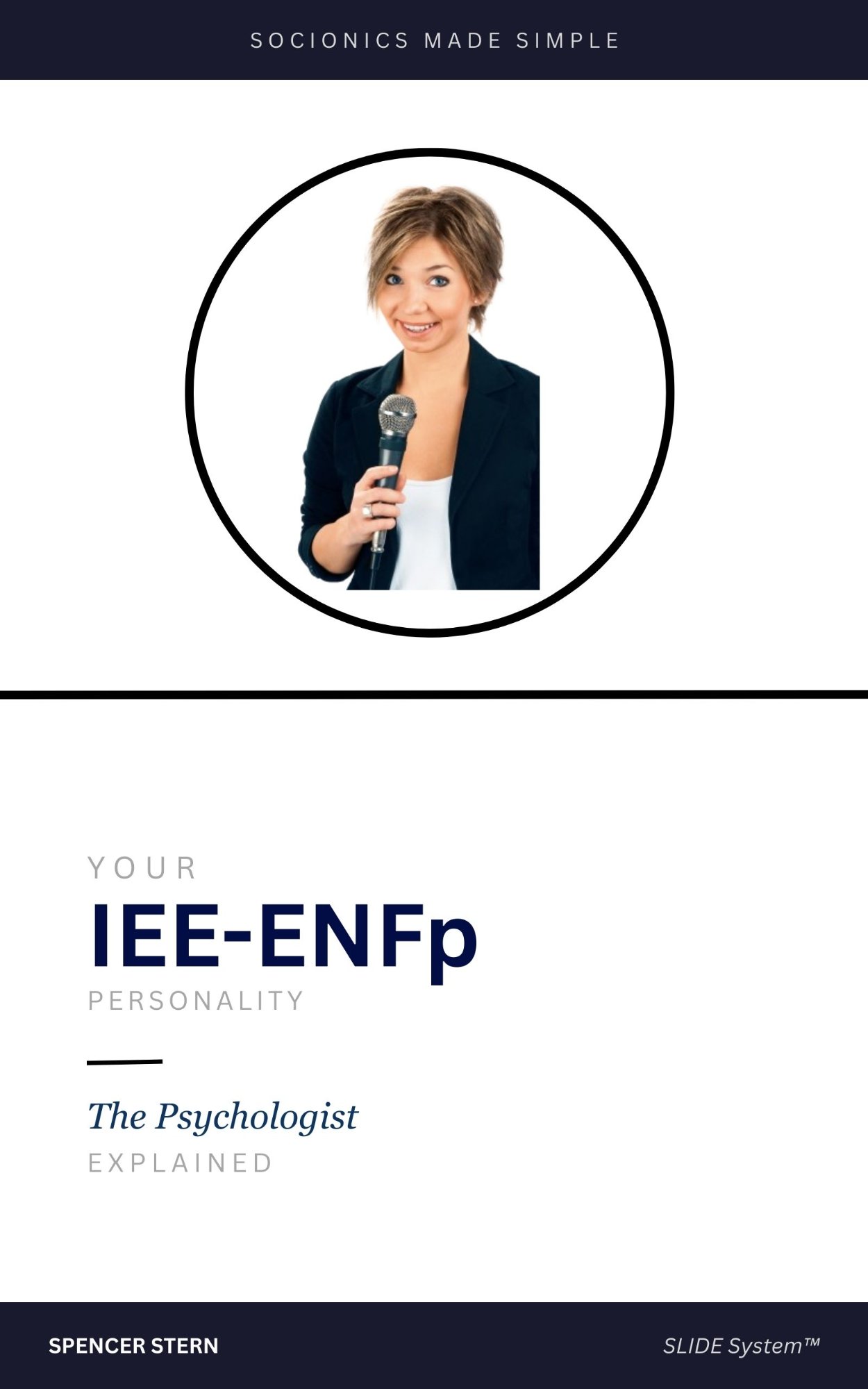
Go deeper with the IEE: The Psychologist volume from the Socionics Made Simple series — a focused guide to this type's cognitive functions, strengths, blind spots and relationship patterns.
Read the IEE volume on Amazon →