
EIE is one of the 16 Socionics types, known as The Actor or ENFj in MBTI cousin notation. EIE belongs to the Beta quadra and is characterised by leading Extraverted Ethics (Fe) and creative Introverted Intuition (Ni). The Dual of EIE is LSI (The Inspector).
Subtypes: EIE-Fe and EIE-Ni ↓
LSI leads with what EIE needs most. This is the basis of the Dual relation.
Function positions
The eight positions of Model A for EIE. Classical names are shown with SLIDE System™ equivalents; position 4 is also commonly called the PoLR (Point of Least Resistance).
| # | Position | Function | Strength |
|---|---|---|---|
| 1 | Leading (Enthusiastic Driver) | Extraverted Ethics (Fe) | Strong |
| 2 | Creative (Adventurous Discoverer) | Introverted Intuition (Ni) | Strong |
| 3 | Role (Underlying Referee) | Extraverted Logic (Te) | Weak |
| 4 | Vulnerable (Rising Guru) | Introverted Sensing (Si) | Weak |
| 5 | Suggestive (Subdued Dreamer) | Introverted Logic (Ti) | Weak |
| 6 | Mobilising (Hidden Motivator) | Extraverted Sensing (Se) | Weak |
| 7 | Ignoring (Data Recorder) | Introverted Ethics (Fi) | Strong |
| 8 | Demonstrative (Natural Artisan) | Extraverted Intuition (Ne) | Strong |
General Mood
Alarm, dramatism, restraint. Emotions that are purposeful and fully engaged.
The SLIDE System™ View — EIE
Cognitive signature. EIE leads with Social Interest (Fe) as its Enthusiastic Driver and Reality Distillation (Ni) as its Adventurous Discoverer. The result is emotion aimed at a story. Where other expressive types read the immediate mood, the EIE reads the arc — where a situation is heading, what it means, how it will be remembered — and uses emotional force to move people toward that unfolding. The leading attitude commands atmosphere with real rhetorical range; the creative attitude supplies the sense of destiny and consequence that gives the emotion its direction. EIEs feel the rising and falling action of events and instinctively cast themselves and others into the roles a moment seems to demand. Their thinking is dramatic and symbolic rather than procedural: they are drawn to significance, to turning points, to the meaning beneath the surface. The recognisable texture is heightened presence. An EIE can lift a room to conviction or foreboding, and they experience the flat and the trivial as a kind of starvation — they want events, and people, to matter.
Strengths. The strong end of the EIE stack is built to move people through meaning. Leading Social Interest (Fe) supplies commanding emotional expression, while second-position Reality Distillation (Ni) supplies foresight and narrative depth — a feel for how things will resolve and what they signify. Beneath the surface, the Data Recorder position (Fi, seventh) gives EIEs a sharper private read on individual loyalty than their theatrical surface implies, and the Natural Artisan position (Ne, eighth) lets them improvise possibilities and alternatives with ease. The combined effect is a type made for mobilising conviction: rallying a group toward a cause, articulating what a moment means, foreseeing where a trajectory leads and dramatising it so others finally feel the stakes. EIEs are at their best where a situation needs vision and emotional leadership, not merely management. The EIE careers page goes further: how EIE works, what drains them at work, and the fields that tend to suit them.
Blind spots. The cost is carried by Dynamic Stabilization (Si) in the Rising Guru position — the EIE's Point of Least Resistance. Ordinary physical comfort, rest, pacing, and the steady maintenance of health and calm are genuinely hard for them to track. EIEs can drive themselves and others past sustainable limits, ignoring bodily signals until the crash arrives, and they are uneasy with the undramatic upkeep that keeps life running. The weak Underlying Referee (Ti, third position) compounds this: cold structural consistency can feel like a cage against their sense of meaning, so they may bend logic to the narrative rather than the other way round. None of this is instability for its own sake — it is a real difficulty with the low, even register of ordinary maintenance. Treated with care, the EIE does best beside someone who supplies the grounding they cannot generate.
Under stress. The EIE's classified stress disposition is Hyperesthetic — acutely attuned to the emotional and social field, thin-skinned in a way that fuels their insight and also exposes them. The need is to feel elevated: respected as a source of meaning, vision, or moral clarity. When that recognition is absent and the environment feels indifferent, the sensitivity that powers their art turns inward as a pervasive sense of inadequacy. Under sustained load, or when the Si vulnerability is repeatedly triggered by physical depletion, the EIE can escalate — becoming more intense, more catastrophising, more prone to dramatising the wound rather than tending it. Their own profile points to the adjustment: detach a little, take the slights with a pinch of salt, reduce the emotional investment in every signal. A stressed EIE recovers when the significance they seek is genuinely acknowledged and their body is allowed to rest.
In relationships. The EIE's natural counterpart is the LSI (The Inspector), and the pairing clarifies the type's needs. EIEs offer emotional depth, inspiration, and a sense that being with them means being part of something larger than the everyday. What they need in return is structure and steadiness: someone whose calm discipline and clear principles give their expansive vision a spine, who is not swept away by the drama and can hold the line when they cannot. Without that anchor, EIEs can burn hot and scatter, exhausting themselves on intensity. In love and friendship they are ardent, attentive, and fiercely engaged with a partner's inner life, and they flourish opposite someone whose grounded reliability turns their vision into something that can actually be built and sustained. The EIE relationships page goes further: what EIE needs from a partner, where the friction comes from, and how to communicate with them.
A Classical Perspective
For readers interested in how EIE has traditionally been described in the Socionics literature, the following is a classical account:
To be or not to be? A serious person focused on global problems. The EIE sees the world in dramatic, even tragic colours, and expects all kinds of trouble. Beethoven's four notes — the theme of fate — sound like the theme of their life. They take personal problems and address them on a global scale, while often striving to give something back to humanity in return.
Romantic. Prone to permanent doubt and wavering. They can seem to those around them to be an irritable, easily excitable individual — any unnecessary movement puts them off, because the world already seems too dynamic as it is. They do not like to take initiative. They value feeling above cold-headed analysis.
Strategist. Knows how to time their efforts. They enter a situation bravely, but only after carefully studying it and preparing everything in advance. They wait for the right moment, make arrangements for any possible turn of events, anticipate problems, and then act assertively — without leaving anything to chance.
They do not take their work lightly and feel responsible for completing whatever they undertake. They struggle for victory at any cost — it is easier to suffer outright defeat than to settle for a compromise. In emergency situations their usual caution disappears without trace.
Good vs. evil. The EIE never does what they consider evil, and is very intolerant of evil in others. However, their ethical theory is based on their own principles, without deference to custom or authority. Their views on good and evil are sometimes strikingly original. In any case they act on them consistently and defend them insistently.
Attentive to people. Sometimes even imposing and demanding, they sympathise with others and try to help them in hard times. They are not easy to get along with — they are not lighthearted about life. More likely than not, they make a devoted family person.
They express their feelings for a partner not so much through material care as through dramatic narratives and warnings against possible dangers. This quality is especially important for their dual (the LSI), who is not naturally skilled at forecasting future events.
You may call the EIE late at night; asked "Did I wake you?" they will reply cheerfully "You did!"
Unaesthetic in routine. They dislike carrying out mundane chores in the presence of others and generally cannot work while being watched. If possible they will send everyone away on an errand first. They are very worried that their movements might appear clumsy or inelegant.
Proud. They carry themselves with a characteristic, seemingly arrogant bearing. People may get the impression they are acting, inflating their own importance. They are a good leader.
→ See notable EIE personalities for real-world examples of this type in action.
Small Groups
The EIE careers page reads EIE's club and five work groups through the type's Model A positions, alongside what drains them at work and the fields that tend to suit them.
| Group | Membership |
|---|---|
| Quadra | Beta |
| Club | Humanitarian |
| Temperament | Rational-Extravert |
| Stimulus | Distinguished |
| Argumentation | Guardian |
| Romance Style | Victim (Gulenko) |
| Communication Style | Passionate (Gulenko) |
| Pedagogic Need | Utopianist (Stern) |
| Stress Behaviour | Hyperesthetic (Kretschmer) |
See how your club shapes your work
Intertype Relations
The EIE relationships page sets these out from most to least supportive, alongside what EIE needs from a partner and where they meet friction.
| Relation | Type |
|---|---|
| Identity | EIE (ENFj) |
| Dual | LSI (ISTj) |
| Activator | SLE (ESTp) |
| Mirror | IEI (INFp) |
| Kindred | ESE (ESFj) |
| Semi-dual | LII (INTj) |
| Business | LIE (ENTj) |
| Quasi-identity | IEE (ENFp) |
| Benefactor | ILE (ENTp) |
| Beneficiary | SEE (ESFp) |
| Supervisor | SEI (ISFp) |
| Supervises | ILI (INTp) |
| Super-ego | LSE (ESTj) |
| Extinguishment | EII (INFj) |
| Mirage | ESI (ISFj) |
| Conflict | SLI (ISTp) |
Reinin Attributes
| Dichotomy | EIE |
|---|---|
| Judicious/Decisive | Decisive |
| Subjectivist/Objectivist | Subjectivist |
| Democratic/Aristocratic | Aristocratic |
| Process/Result | Process |
| Carefree/Farsighted | Carefree |
| Yielding/Obstinate | Obstinate |
| Static/Dynamic | Dynamic |
| Tactical/Strategic | Strategic |
| Constructivist/Emotivist | Constructivist |
| Positivist/Negativist | Negativist |
| Asking/Declaring | Asking |
See the Reinin dichotomies article for descriptions of each trait.
EIE subtypes: EIE-Fe and EIE-Ni
EIE-Fe is the leading subtype of EIE, which Meged and Ovcharov call the Ethical subtype, or Educator: the more restrained, principled EIE, intense inside and composed outside, who holds people to standards of conduct.
EIE-Ni is the creative subtype of EIE, which Meged and Ovcharov call the Intuitive subtype, or Actor: the more theatrical, changeable EIE, artistic and talkative, who senses the mood of a room and steers it.
The codes follow EIE's two strongest elements, Extraverted Ethics (Fe) and Introverted Intuition (Ni), and are my shorthand for Meged and Ovcharov's scheme.
| EIE-Fe (Educator) | EIE-Ni (Actor) | |
|---|---|---|
| Comes across as | Composed, correct, guarded about their feelings | Theatrical, talkative and hard to predict |
| In a disagreement | Corrects others' conduct; can turn cold and haughty | Ironic, caustic, quick to flare |
| With new ideas and work | Plans ahead and persists until the goal is reached | Curious and original, but changes course on doubts |
| Typical friction | Unasked remarks about how people should behave | Moods steer the room; decisions keep shifting |
EIE-Fe: the Ethical subtype (Educator)
Meged and Ovcharov's Educator is EIE with Extraverted Ethics (Fe) leading at full strength, and I think that is why the emotion is held rather than shown. Fe here takes the form of standards: how people ought to behave, starting with the EIE themselves. So the drama stays inside, other people's conduct gets commented on, and a goal is pursued patiently. Introverted Intuition (Ni) supplies the planning ahead. The Actor lets the same intensity out on stage.
EIE-Ni: the Intuitive subtype (Actor)
In Meged and Ovcharov's Actor (their name for this subtype only, not this site's name for the whole type), Introverted Intuition (Ni) has come forward, and my reading is that the EIE becomes a reader and shaper of moods rather than a keeper of standards. Ni senses where a room's feeling is heading, and Fe then plays to it, with pathos, irony or charm. The same Ni brings the doubts and changes of mind that the Educator, holding to fixed rules, seldom shows. Of the two, EIE-Ni is the one most easily taken for IEI, EIE's Mirror, which leads with Introverted Intuition: to tell them apart, try the Type Disambiguator.
Not every school accepts subtypes: Kovalenko and Zvonaryova put the differences between people of one type down mainly to experience and upbringing. So a subtype describes how EIE can look, never whether someone is EIE at all (their argument in full).
Nor are these Gulenko's DCNH subtypes, a separate scheme: EIE-Ni is not the DCNH Creative subtype.
Subtypes, names and traits from V.V. Meged and A.A. Ovcharov, Kharaktery i otnosheniya [Characters and Relationships], Armada-press, Moscow, 2002 and, where it differs, their article "Vizualno-povedencheskie kharakteristiki tipov lichnosti i dvukh osnovnykh podtipov" [Visual and behavioural characteristics of the personality types and their two main subtypes], Sotsionicheskaya gazeta, no. 1, 22 November 2003, with physical description left out; the caution from R.K. Kovalenko and N.A. Zvonaryova, Sotsionika: polnyy kurs lektsiy [Socionics: A Complete Lecture Course], NITs Sotsionicheskogo Analiza / SibAK, Novosibirsk, 2020, chapters 1 and 13. The element codes and every interpretation are my own.
Type Comparisons
Detailed side-by-side comparisons of EIE with every other type — covering function stack differences, the intertype relation, and how each pairing tends to play out.
From MBTI
If you arrived at Socionics through MBTI, these pages explain how the closest MBTI types map to EIE:
Notable EIEs
For the function running at full volume, Jules Winnfield in Pulp Fiction is one of the more precisely observed EIE portrayals in mainstream film.
Read the Book
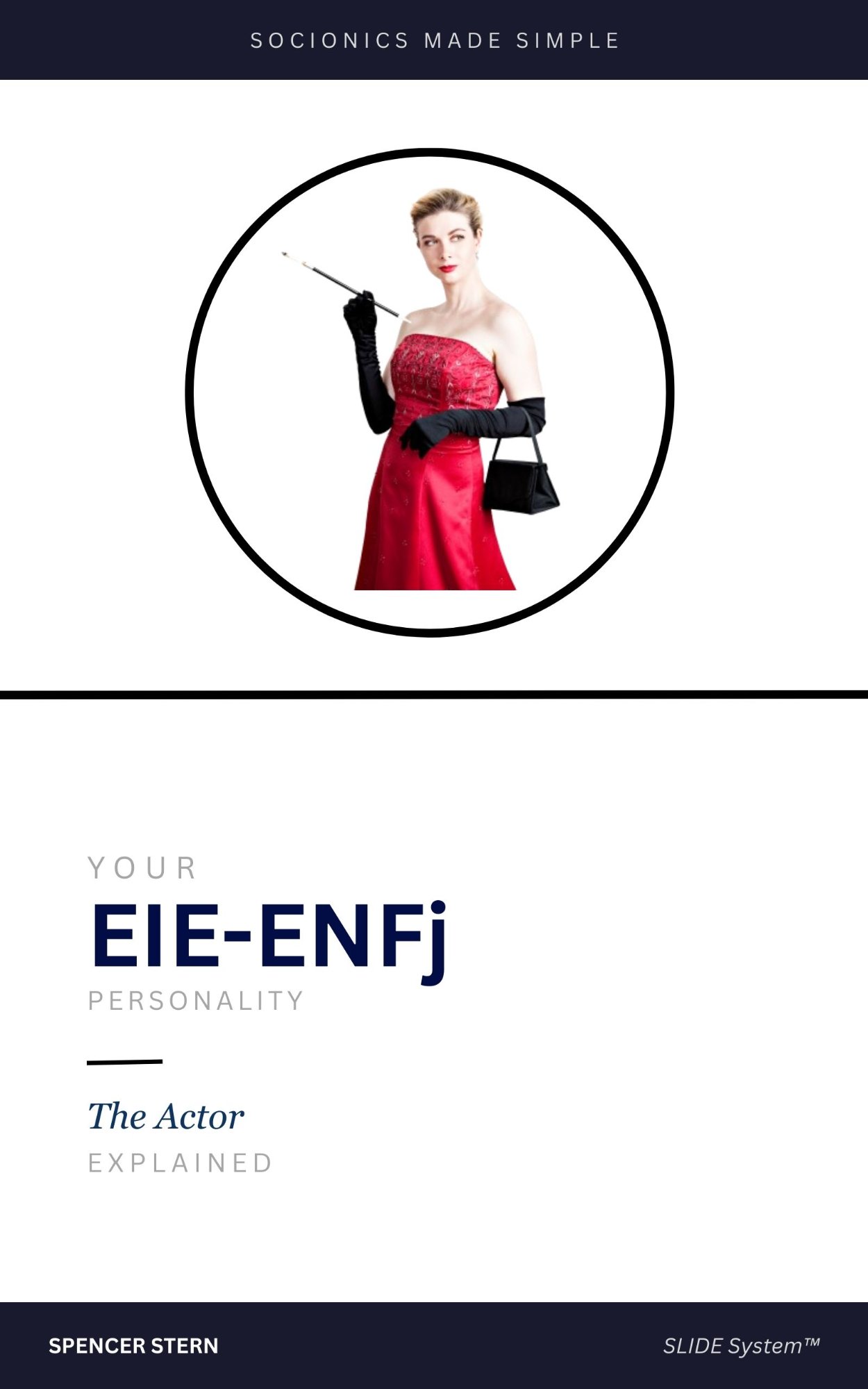
Go deeper with the EIE: The Actor volume from the Socionics Made Simple series — a focused guide to this type's cognitive functions, strengths, blind spots and relationship patterns.
Read the EIE volume on Amazon →